
Wayne County Court Records After a Jail Arrest
After a Wayne County arrest, the jail roster and the court record answer different questions. The roster shows custody status, booking history, bond entries, charge labels from the jail system, and hearing dates tied to those charge numbers. Court records after an arrest show the formal case: the prosecutor's filed charges, the register of actions, hearing schedule, court events, and final disposition when one exists.
For custody, booking, and local jail identifiers, use jail inmate records. For the narrower question of whether a booking photo is visible or requestable, use jail mugshots. For court records after a jail arrest, start with the court that has jurisdiction. Detroit misdemeanor cases and felony first appearances often begin in 36th District Court. Felony cases bound over from district court proceed in the Third Judicial Circuit Court criminal division at the Wayne County Criminal Justice Center.
How to Find Wayne County Court Records After an Arrest
Use the case system that matches the stage of the case. The 36th District Court Case Inquiry System covers public cases filed with that court from 1990 to present and has no charge for online inquiry. The court warns that online ROAs and data are not certified records and not for background checks. Its court schedule search is limited to 1,000 proceedings, so the court recommends searching by name first to obtain a specific case number before searching schedules.
- Check the Wayne County jail profile first if the case number or docket number is unknown.
- Search the 36th District Court system for Detroit misdemeanor matters, felony arraignments, probable cause conferences, and preliminary examinations.
- Search Third Circuit Odyssey Public Access for circuit court criminal records after bindover or for filed circuit matters.
- For certified copies or document images, use the court or clerk request channel because both online systems limit what documents can be viewed online.
The official 36th District Court inquiry page is captured from the court's case inquiry and schedule page.
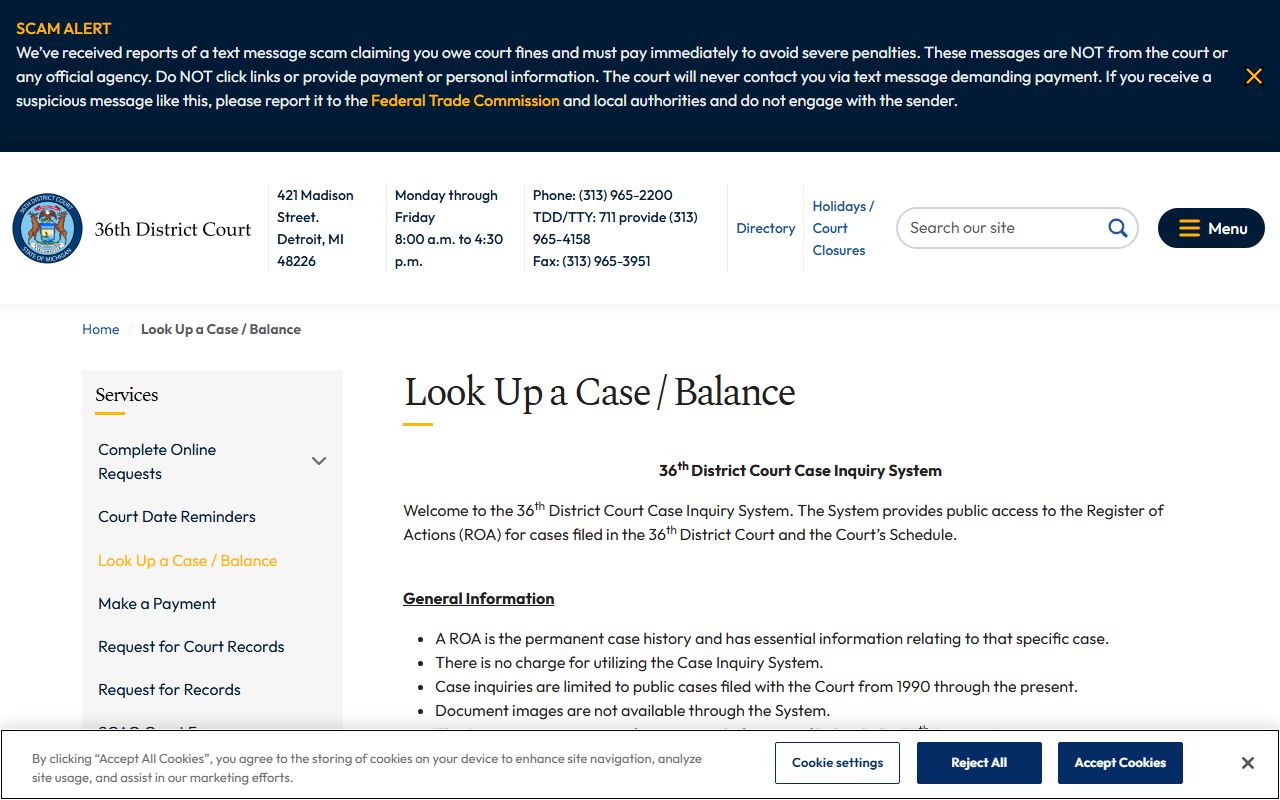
That system is useful for the early court record, while the Third Circuit system becomes important after felony bindover.
How Charges Get Filed After an Arrest: Complaint, Information, and Indictment
Michigan counties use a Prosecuting Attorney, not a District Attorney. In Wayne County, Prosecutor Kym L. Worthy leads the Wayne County Prosecutor's Office. The county prosecutor page says the office prosecutes felony cases throughout Wayne County and handles over 52 percent of all felony cases in Michigan. Prosecutor review is the point where arrest allegations and booking labels become filed court charges, are amended, are declined, or are dismissed.
The charging document matters because it is the bridge between the jail arrest and the court record. A complaint can start a case or support an arraignment. An information is a formal prosecutor filing commonly used after felony bindover. An indictment may be used in some serious matters, although the research for this page focused on the normal district-to-circuit pathway.
| Complaint | Information | Indictment | |
|---|---|---|---|
| Filed By | Prosecutor, often based on police reports and warrant review | Prosecutor after the early felony stage | Grand jury process when used |
| Common For | Misdemeanors and initial felony proceedings | Felonies bound over to circuit court | Serious or complex felony matters |
| Record Role | Starts or supports the filed case | Defines the circuit court charge set | Creates a formal accusation through grand jury action |
Charge Status in Court Records After a Jail Arrest
Booking charges can differ from the charges a prosecutor finally files. The jail profile may show charge descriptions, docket numbers, court dates, dispositions, crime class, and sentence information, but SheriffConnect warns that specific charge, court case, and bond details must be confirmed with the court of jurisdiction. Charge status can change as police reports are reviewed, plea negotiations occur, preliminary examination issues are resolved, or a judge rules on motions.
| Status | What It Means |
|---|---|
| Pending | The charge has been filed and remains unresolved in the court record. |
| Amended or Reduced | The prosecutor or court changed the charge, often after review, plea negotiations, or hearing outcomes. |
| Dismissed | The charge was removed from the case by court action or prosecutor decision. |
| Bound Over | A felony matter moved from district court to Third Circuit Court after the early felony stage. |
| Disposed | The charge reached an outcome such as plea, verdict, dismissal, or sentencing. |
Bond and Release After an Arrest
Wayne County bond information is split between the court and the jail. Bonds are accepted at the Wayne County Jail every day, 24 hours a day, except Monday through Friday from 8:30 a.m. to 4:30 p.m. During those weekday court hours, cash bonds and fines should be paid at the court of jurisdiction, such as Third Circuit Court or 36th District Court. After payment at court, the court bond receipt can be provided to the Wayne County Sheriff's Office Jail Division for processing.
The Sheriff's bond page adds several local caveats. Only people age 18 or older may post bonds. The bond window is first-come, first-served, but the person must have arrived and been processed into the Wayne County jail system before release can be completed. Before release, the jail runs a LEIN check for additional wants or warrants. If another charge, warrant, hold, or detainer exists, paying one bond may not release the person.
| Bond Type | How It Works |
|---|---|
| Cash Bond | Money paid directly for release, usually handled by the court during weekday court hours. |
| Surety Bond | Bond supported by an approved surety or bond company, subject to court and jail processing. |
| Personal Recognizance | Release based on a written promise to appear without upfront cash. |
| No-Bond Hold | Custody status where payment alone will not release the person. |
| Detainer or Hold | Another agency or case can block release even after a local bond is paid. |
Warrants That Lead to an Arrest
No official Wayne County Sheriff active-warrant search page was located in the reviewed sources. If a warrant has already resulted in custody, the Wayne County Sheriff Inmate Inquiry may show the person after booking. The inspected profile included a Failure to Appear charge row and court dates tied to charge numbers, but it did not display a separate warrant-number field in the text view.
For Detroit misdemeanor and felony-first-appearance matters, use 36th District Court case inquiry or contact the Traffic/Criminal Division. For circuit felony matters, use Third Circuit Odyssey Public Access. Michigan State Police ICHAT can be useful for public criminal-history searches, but MSP says warrant information is not available through ICHAT. For clearing a bench warrant, resolving failure to appear, or deciding where to pay bond or fines, rely on the issuing court or qualified legal counsel.
Charges vs. Convictions
An arrest and a charge are not the same as a conviction. A jail roster can show that a person was booked and that charge labels were entered. A court record can show that charges were filed and later amended, dismissed, resolved by plea, tried, or sentenced. The distinction is essential because a public case entry may remain visible even when the charge did not become a conviction.
| Charge | Conviction | |
|---|---|---|
| Stage | Formal accusation in the case | Outcome after plea, verdict, or finding |
| Proof Level | Lower than trial proof, depending on stage | Beyond a reasonable doubt or admitted by plea |
| Public Record | Often visible unless restricted | Often visible unless sealed, set aside, or otherwise restricted |
| Meaning | Not proof of guilt | Legal finding or admitted responsibility |
Sealed vs. Expunged or Set Aside Court Records
Michigan law uses set-aside language for eligible convictions under MCL 780.621. A set-aside changes public access to qualifying conviction information, but eligibility and effect depend on the case, offense, and statute. Do not assume that every arrest, dismissal, conviction, or booking photo disappears from every system. Court files, law-enforcement records, jail records, state criminal history, and third-party copies can follow different rules.
| Restricted or Sealed | Expunged or Set Aside Under Michigan Law | |
|---|---|---|
| Visibility | Public access may be limited by court rule, statute, or order. | Public conviction access changes for eligible records after the legal process is completed. |
| Access | Courts and agencies may retain limited or official access. | Some government and law-enforcement uses may remain available under law. |
| Eligibility | Depends on record type, case category, and court order. | Depends on MCL 780.621 and related Michigan set-aside provisions. |
Background Check Considerations
Online court portals and jail rosters are not substitutes for a lawful background-check process. Third Circuit Odyssey Public Access warns that its online records are unofficial and should not be used for background checks. The 36th District Court warns that online ROAs and other data are not certified records and not for background checks. For certified copies, use the court or clerk records request process.
Important: Do not use jail, court, or custody lookup information for credit, employment, housing, insurance, or another FCRA-covered decision.
Restricted Court Records After an Arrest in Wayne County
Some records are not fully public online. The Third Circuit system provides case search results, registers of action, and civil judgments for public cases, but documents are not currently accessible online. The court also warns that name searches can be unreliable because multiple people can share names or birth dates and some criminal offenders use aliases. In-person public access kiosks are available in the lower level of Coleman A. Young Municipal Center, and paper records can be requested through the Wayne County Clerk's Office.
The 36th District Court records request form requires all fields to be completed and lists a copy cost of $1.25 per page. Required fields include requestor name, address, city, state, zip, phone number, email address, date requested, case type, case number, title of document, and preferred delivery method. Traffic/Criminal Division contact is 313-965-5113. For Wayne County records outside the online court portals, use the clerk, the court of jurisdiction, or the Sheriff's FOIA process, depending on the record sought.
The Third Circuit case-search source is captured from the official Third Judicial Circuit case search page.
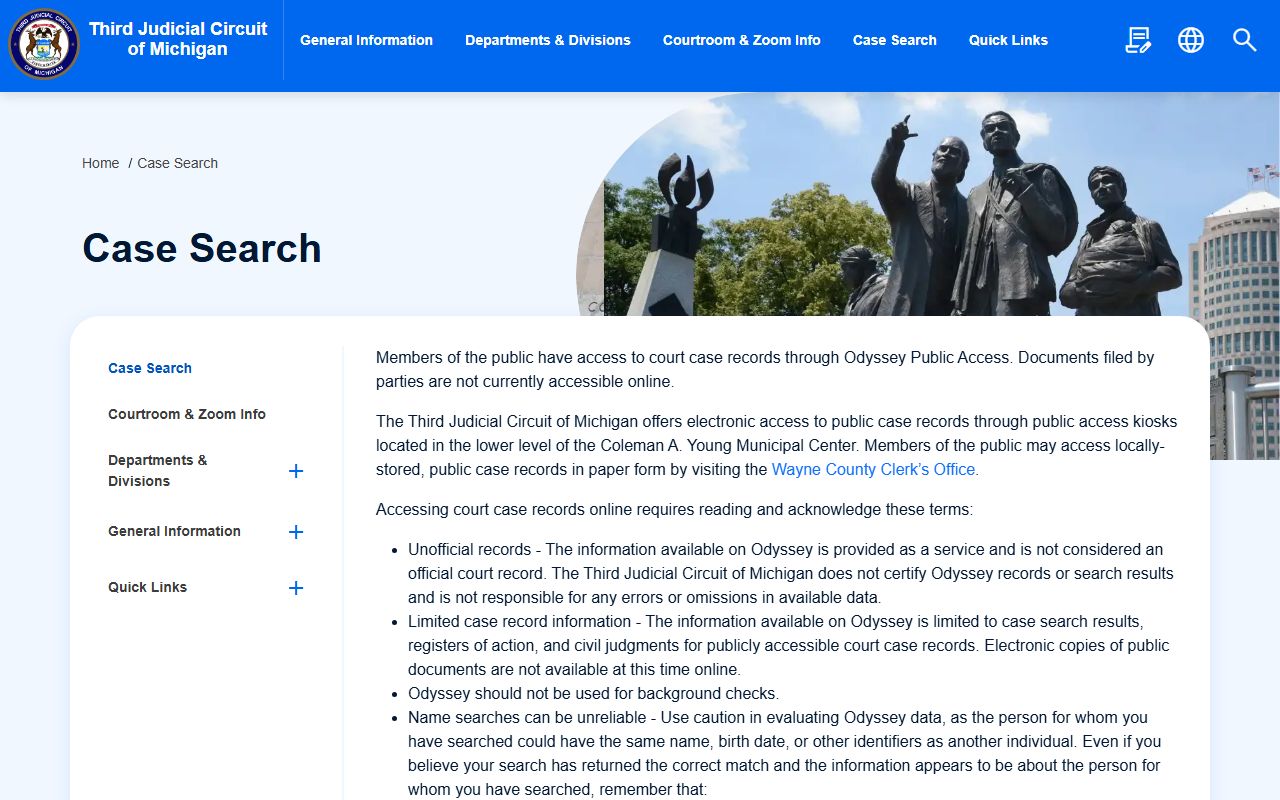
The image reflects the main limitation users must remember: online case lookup is a starting point, not a certified document repository.